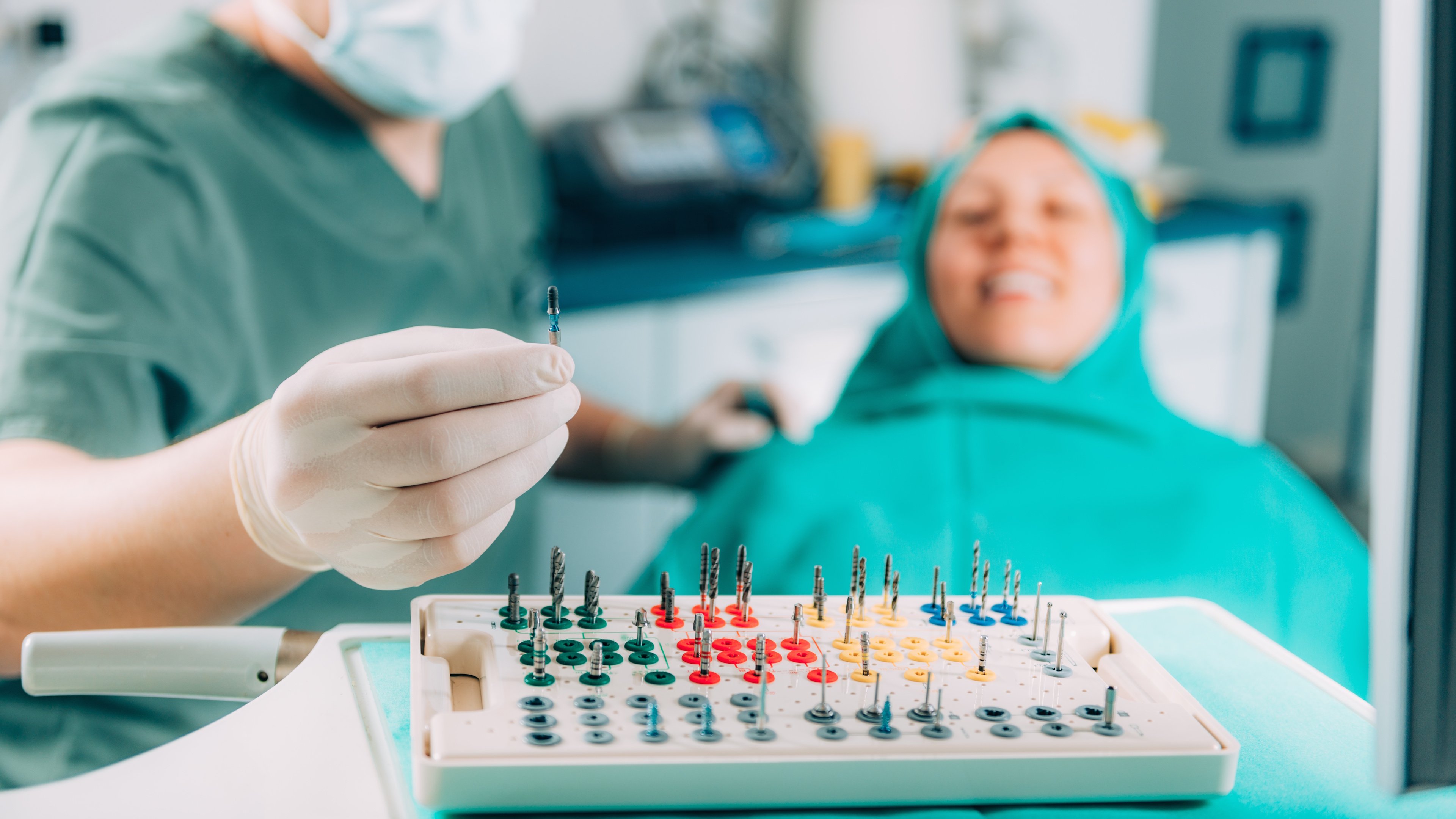

A key factor for treatment success is for the clinician to be thoroughly familiar with the specific implant system being used—specifically, the type of guided surgery protocol implemented by that manufacturer. Below is a summary of the most common guided surgery approaches and guide classifications.
Classification by Anatomical Support Type
In guided surgery, surgical guides can be designed to rest on different intraoral structures depending on the patient's clinical situation:
- Tooth-Supported Guides (Tooth-Borne): Positioned directly over the patient's remaining natural teeth. These are used in partially edentulous cases, are relatively easy to fabricate, and offer exceptionally high accuracy and stability.
- Mucosa-Supported / Soft Tissue-Supported Guides (Mucosa-Borne): Rest directly on the oral soft tissue, functioning similarly to a full denture. Typically used for fully edentulous patients, these guides are almost always secured in place using dedicated fixation (bone) pins to prevent intraoperative movement.
- Bone-Supported Guides (Bone-Borne): Positioned directly onto the underlying bone of the maxilla or mandible after reflecting a full-thickness flap. These guides rely on the 3D-segmented bone topography for precise seating and stability.
Classification by Level of Guidance
- Pilot Guidance (Pilot-Guided): The surgical guide is used only for the pilot drill to set the initial position, axis, and full depth of the osteotomy. The site is then sequentially enlarged freehand using standard drills.
- Partially Guided: The surgical guide is used for the entire osteotomy drilling sequence, but it is removed prior to implant insertion (the implant is placed freehand).
- Fully Guided: Every step of the surgical workflow—from the initial pilot drill through the full drill sequence to final implant placement—is executed directly through the surgical guide.
Classification by Sleeve and Key Configuration
- Sleeve-in-Sleeve / Keyed Systems ("Key-in-Key"): Removable metal drill keys (reducers) with handles are inserted into a master sleeve within the surgical guide to accommodate each drill diameter sequentially.
- Examples: Straumann, Neodent, and BioHorizons.
- Keyless Systems: Drills insert directly into fixed metal master sleeves without requiring separate reduction keys or handles. Depth is controlled by built-in stoppers directly on the drills.
- Examples: Camlog.
- Sleeveless Systems: The 3D-printed guide contains no metal sleeves. Instead, specialized drills feature a widened collar that guides the drill and acts as a physical stop directly against the resin guide material. Dedicated drill sequences are matched to specific implant dimensions (e.g., specific drill sizes for a 4.0 mm × 10 mm implant).
- Examples: Hiossen and MegaGen.
Every implant manufacturer incorporates specific nuances into its Guided Surgery Protocol, even when based on these foundational principles.